


The steps, from first call to keys
- 1
Free consultation
By video call or WhatsApp at a time that suits your time zone: your plot, budget and timeline.
- 2
Site and land assessment
We check the plot, access and soil, and work with your lawyer on the title. See buying land from abroad.
- 3
Design and approvals
Architectural and structural drawings, then the building permit application.
- 4
Open-book BOQ and contract
An itemised bill of quantities, a stage payment schedule and an inspection plan, all in a written contract.
- 5
Build in six inspected stages
Each stage is inspected and evidenced before the next payment is due (details below).
- 6
Handover and defects period
Keys, as-built drawings, electrical and plumbing layouts, structural certificates and a 6–12 month defects liability period.
The stage gates
This is what is checked at each gate and what you receive as evidence. The chart shows how a typical build budget splits across the stages (from our 2026 cost guide); your contract sets the actual payment schedule.
Where the money goes
Six stages, six checks, six payments
Each bar is a stage’s typical share of the build budget. At the end of every stage the work is inspected and you see the evidence before the next payment is due.
- 1
Design & site prep5–10%
Drawings, structural design, soil test, building permit, clearing and setting out.
Inspected, then paid
- 2
Foundation10–15%
Excavation, blinding, footings or raft, foundation walls, DPC. More on waterlogged or reclaimed land.
Inspected, then paid
- 3
Frame & blocks20–30%
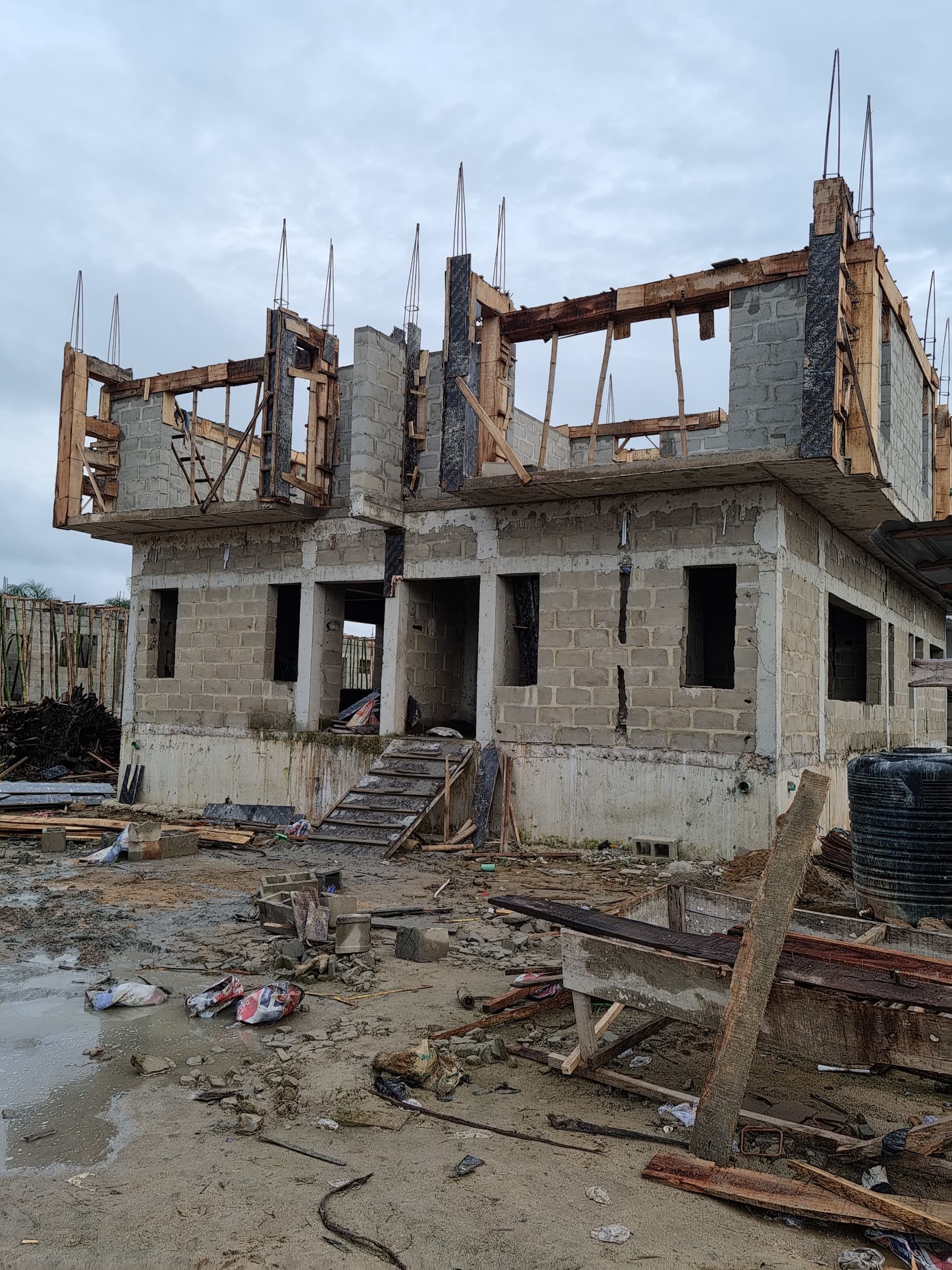
Columns, beams, blockwork, lintels; for a duplex also the first-floor slab and stairs.
Inspected, then paid
- 4
Roof8–12%
Timber or steel trusses, covering (stone-coated or aluminium), fascia and gutters.
Inspected, then paid
- 5
Services10–15%
Electrical wiring and fittings, plumbing, septic or soakaway, water storage.
Inspected, then paid
- 6
Finishing30–40%
Plaster, screed, tiles, ceilings, paint, doors, windows, sanitary ware, kitchen.
Inspected, then paid
| Stage | What the inspector checks | Evidence you receive |
|---|---|---|
| Mobilisation and setting out | Plot boundaries, building position and levels match the approved drawings. | Setting-out photos, survey beacons, inspector’s sign-off. |
| Foundation | Excavation depth, rebar size and spacing, concrete grade (cube test samples), DPC. | Photos before every concrete pour, cube test results. |
| Frame and blockwork | Column and beam reinforcement, block quality, wall alignment, lintels; for a duplex the first-floor slab. | Pre-pour checks, block samples, slab inspection. |
| Roof | Truss sizes and fixings, covering, flashing and gutters; building watertight. | Roof inspection report, drone or walk-round video. |
| Services | Electrical wiring and earthing, plumbing pressure test, drainage falls, septic/soakaway. | Test certificates and photos before walls are closed. |
| Finishing and handover | Plaster, tiling, ceilings, joinery, fittings, snag list cleared. | Snag list, as-built drawings, warranties, keys. |
Inspection before every payment
Who checks your build? You choose.
Every stage is inspected before you pay for the next one. Use our team, add an independent firm, bring your own inspector, or combine them.
Option A · Included in every build
Our inspection team
Checks each stage against the drawings and sends you the report before the next payment is due.
- Engr. J.O. Owolabi · Chief inspector
- Arch. E.A. Nwabueze · Adjunct inspector
- Engr. Bello Hasani · Inspector
Option B · Independent of Artemis
An independent firm from our panel
Choose one of three to four outside COREN-registered firms to check the stages you want, for a second opinion that doesn’t work for us.
- Panel firm · being appointed · Structural and concrete works
- Panel firm · being appointed · Building services (electrical and plumbing)
- Panel firm · being appointed · General building and finishes
- Panel firm · being appointed · Quantity surveying and valuations
Firms are named here as each agreement is signed.
Option C · Your choice
Bring your own inspector
Any qualified engineer or surveyor you choose. We give them site access at each stage gate and share the drawings and bill of quantities; their fee is paid by you.
- Your engineer, surveyor or architect
- Site access at every stage gate
- Drawings and BOQ shared with them
Whoever inspects, the rule is the same: no report, no payment. See the stage gates
Proof, not promises
- Our inspection team: Engr. J.O. Owolabi (chief inspector); Arch. E.A. Nwabueze (adjunct inspector); Engr. Bello Hasani (inspector). You can also appoint an independent inspector of your choice to check any stage before you pay.
- COREN registration: Engr. Utibe Collins Nneke — R.74112 · check the register
What you see while we build
A live site camera, weekly reports with dated photos, an inspection report at each stage gate, drone or walk-round video at key milestones, and your private client portal with stages, payments, documents and a defect request form.
How often you hear from us
What you see while we build
Not a relative’s phone photos: dated, regular evidence you can check from anywhere.
How long it takes
| Project | Typical time from approval to handover |
|---|---|
| 2- or 3-bedroom bungalow | 6–12 months |
| 4-bedroom bungalow | 8–12 months |
| 4- or 5-bedroom duplex | 12–24 months |
| Renovation | Weeks to months, depending on scope |
How your money is protected
Five layers between your money and the site
Each layer catches what the one before might miss. Together they mean you never pay for work you haven’t seen.
Stage payments
You pay for one stage at a time, never ahead of the work.
Inspection
Every stage is checked before you pay: by our team, an independent firm, or your own inspector.
Open-book BOQ
Every bag of cement and tonne of rebar itemised, so you can compare with market prices.
Insurance
Contractor’s all-risk cover with a NAICOM-licensed insurer you choose, in your name.
Written contract
Scope, payments, changes and disputes agreed in writing before work starts.
Building contract essentials
Every project has a written contract that attaches the drawings and BOQ and sets out: the stage payment schedule, the inspection at each gate, the programme, how changes (variations) are priced and approved, insurance, the defects liability period, and how disputes are resolved.